

 0
 0
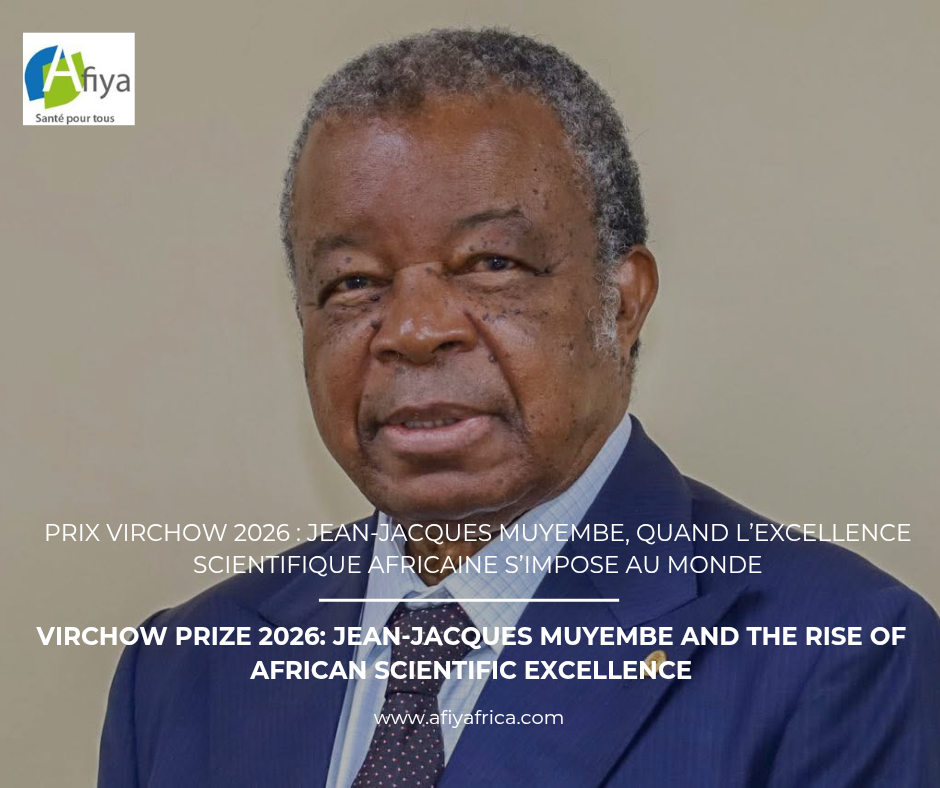
Some awards recognize a career. Others tell a story. The story of a continent, a disease, and a man who, for decades, has never stopped searching, understanding, and passing on knowledge.
In 2026, the Virchow Prize for Global Health honors two leading figures in the fight against Ebola: Professor Jean-Jacques Muyembe-Tamfum, Congolese physician and researcher, and Professor Peter Piot, the Belgian-British microbiologist. Their distinction recognizes their pioneering work on Ebola and their contribution to epidemic preparedness and response.
But for Africa, this recognition carries a particularly powerful meaning.
Jean-Jacques Muyembe: an African physician at the heart of the Ebola story
In 1976, as the scientific world was only beginning to understand this mysterious and deadly virus, a young Congolese physician was sent to Yambuku, in the Democratic Republic of the Congo, at the epicenter of the first recorded Ebola outbreak.
His name was Jean-Jacques Muyembe.
Fifty years later, his name has become inseparable from the scientific history of Ebola. His encounter with Peter Piot—Muyembe working in the field in the Democratic Republic of the Congo and Piot contributing to the laboratory work in Antwerp that helped identify the virus—became one of the starting points of a scientific journey that would profoundly shape global health.
But Muyembe’s story did not end with that first outbreak.
Over the decades, the Congolese researcher established himself as one of Africa’s leading voices in infectious disease research. As Director General of the National Institute of Biomedical Research (INRB) in Kinshasa, he also became an important figure in international discussions and responses to Ebola.
His career tells a story far greater than individual success: it demonstrates that Africa has scientists capable of generating knowledge about the health threats affecting its own populations—and contributing that knowledge to the world.
From Yambuku to the world: Africa is more than a setting for epidemics
For too long, the international narrative surrounding major African health crises has often been told from outside the continent.
Africa was described as a place where epidemics occurred. International teams came to investigate, collect samples, deploy interventions and develop responses.
The journey of Jean-Jacques Muyembe reminds us of another reality: Africa also produces the scientists who observe, analyze, understand and fight these epidemics.
And this expertise is not merely theoretical.
Fifty years after Yambuku, African scientific expertise remains at the forefront of the response to emerging infectious diseases.
In other words, five decades after the first Ebola outbreak, African science is still answering the call.
An award that goes beyond two men
The 2026 Virchow Prize honors two scientists. But it also tells the story of scientific collaboration that transcends borders.
Muyembe and Piot embody a principle that has become essential to global health: when epidemics strike, no country can face them alone.
Research must be shared. Data must circulate. Local expertise must be strengthened. And, above all, African countries must have the capacity to build and sustain their own systems for surveillance, diagnosis, research and response.
That is the capacity that must continue to be built.
Because when a new infectious threat emerges, the first line of defense is often where the affected populations live: in African laboratories, African hospitals, African universities and among African health professionals.
Jean-Jacques Muyembe: a message to the next generation
Professor Muyembe’s journey also speaks directly to a new generation of African physicians, researchers, biologists and health professionals.
His story tells young scientists across the continent: we can conduct research here, generate knowledge here, innovate here—and advance science on a global scale.
Africa should not remain merely a consumer of health solutions designed elsewhere.
It must also be a producer of knowledge, technologies, vaccines, treatments, data and solutions adapted to its own realities.
Muyembe’s career is a powerful illustration of this possibility.
The Afiyafrica perspective
As the world celebrates this distinction, Afiyafrica chooses to look beyond the award itself.
We see the journey of a Congolese physician who became a global health leader. We see evidence that African scientific excellence exists, is being built, and deserves greater recognition.
Above all, we see an invitation to invest more deeply in the scientists who will shape Africa’s major health discoveries of tomorrow.
Because Africa must no longer be known only as the place where global health emergencies occur. It must also be recognized as a place where solutions are created.
Professor Jean-Jacques Muyembe reminds us that an African researcher can begin his journey in a hospital in Yambuku and, decades later, help change the way the world understands and responds to epidemics.
This, too, is Africa that heals.
Africa that researches.
Africa that innovates.
Africa that knows.
And this Africa deserves to be told.


About Author


OTHER ARTICLES
Kenya Confirms First Imported Case of Bundibugyo Ebola Virus Disease
Ten ambulances and medical equipment strengthen emergency care in The Gambia
Afiya List 2025 : 25 personalities who made an impact on health in Africa in 2025