
 0
 0
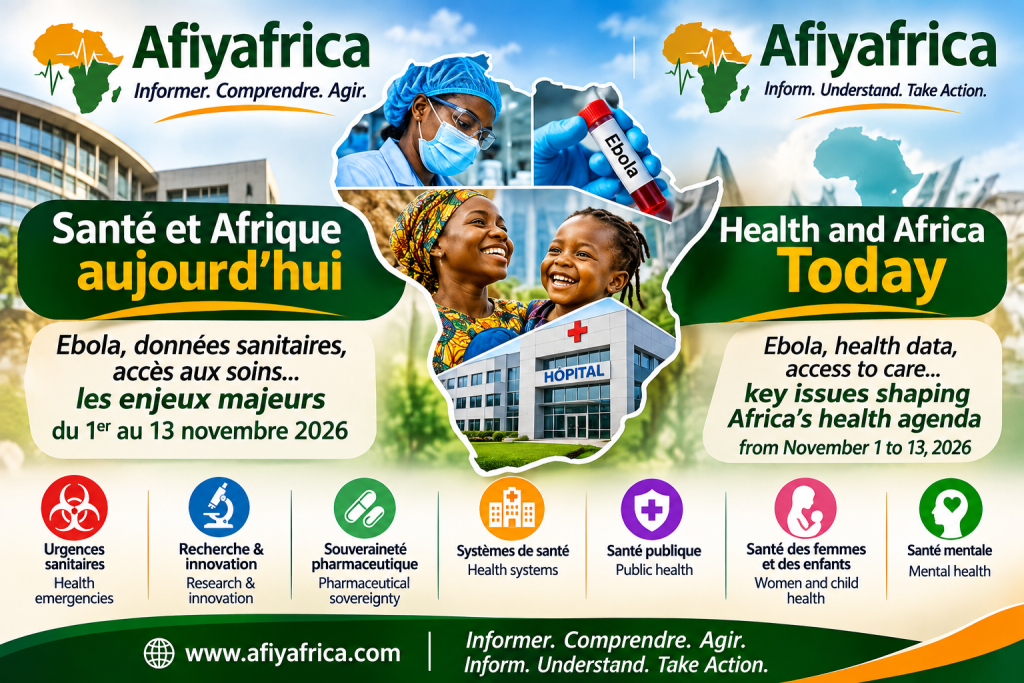
Special Edition | November 1–13, 2026
From the Ebola outbreak in the Democratic Republic of the Congo to advances in health surveillance, emergency response systems and prevention policies, Africa’s health news during the first two weeks of November highlights the continent’s persistent challenges. It also showcases promising initiatives aimed at building more resilient, accessible and self-reliant health systems.
Africa continues to face public health emergencies that underscore the importance of sustained vigilance. At the same time, the continent is undergoing changes that could significantly improve healthcare delivery for its populations. Between epidemics, innovation, public policies and health system strengthening, several developments shaped the African health landscape from November 1 to 13, 2026.
Afiyafrica takes a closer look at the key developments and examines their implications for public health across the continent.
1. Ebola: The Democratic Republic of the Congo continues to face a major outbreak as Kenya reaches an important milestone
The Ebola outbreak caused by the Bundibugyo virus remains a major concern in Central Africa. In the Democratic Republic of the Congo (DRC), community transmission continues, and the outbreak remains a significant challenge for health authorities and their partners.
According to available data as of November 11, covering the situation through November 10, the DRC had recorded 11,114 confirmed cases and 5,433 deaths. Eight provinces are affected, with a significant concentration of cases in Ituri and North Kivu. These figures highlight the scale of the crisis and the difficulties involved in permanently interrupting transmission chains.
The response continues to face several obstacles, including early case detection, contact tracing, access to affected communities, epidemiological surveillance and security challenges in certain areas. Reports of attacks against healthcare workers and health facilities also underline the importance of protecting response teams as a prerequisite for controlling the outbreak.
In Kenya, however, the situation has taken an encouraging turn. On November 11, the last patient still hospitalized was declared recovered and discharged. The nine confirmed cases recorded in the country, including two deaths, were linked to the initial case. The last monitored contacts have also completed their surveillance period.
The country therefore began a 42-day countdown on November 12. If no new cases are reported, the outbreak could officially be declared over on December 23, 2026.
Afiyafrica’s analysis: These developments illustrate two complementary realities. On the one hand, the persistence of a major outbreak requires sustained mobilization and cross-border coordination. On the other, Kenya’s experience demonstrates the importance of early detection, contact tracing, patient care and community engagement. Vigilance must nevertheless be maintained until the official declaration that the outbreak has ended.
2. Addis Ababa hosts a global meeting to strengthen emergency medical teams
From November 3 to 5, Addis Ababa, Ethiopia, hosted the seventh Global Meeting of Emergency Medical Teams (EMTs). This was the first edition to be held in the World Health Organization’s African Region.
The meeting brought together more than 1,000 participants from over 100 countries, including health officials, healthcare professionals, researchers, humanitarian partners and representatives of international organizations.
Its objective was to strengthen national and international capacity to deliver rapid, quality medical care during health crises, disasters and humanitarian emergencies.
During the meeting, 31 new teams received classification and eight others were reclassified according to international standards. Discussions focused in particular on sustainable funding, operational preparedness, quality standards and cooperation between countries.
Participants also made progress towards an agreement aimed at securing sustainable funding for national medical teams and ensuring their long-term integration into emergency response systems.
Afiyafrica’s analysis: Recent health crises have demonstrated that a country’s response capacity cannot rely solely on the occasional intervention of international partners. Developing well-trained, equipped and sustainably funded national medical teams is a strategic investment in Africa’s health sovereignty.
3. Health data: Africa urged to accelerate the transformation of its health information systems
From November 10 to 12, 2026, Nairobi, Kenya, hosted the first Africa Health Data Forum under the theme: “Better Data, Better Health for All.”
More than 300 participants from 51 countries attended the meeting, which focused on strengthening health information systems across Africa.
During the forum, WHO presented findings from a 2024 assessment conducted in 40 Member States of its African Region. The overall maturity level of health information systems was rated at 59 out of 100, highlighting persistent shortcomings in the collection, analysis, governance and use of health data.
Yet health data are essential for public policy planning, epidemic surveillance, vaccination programme evaluation and resource allocation. They also help identify population needs and inequalities in access to healthcare.
Discussions in Nairobi emphasized the need to reduce fragmentation across digital systems, improve platform interoperability and strengthen African countries’ ownership of their health data.
Afiyafrica’s analysis: Reliable data are not merely a statistical requirement. They are essential for sound health policy decisions. Without complete and up-to-date information, governments risk planning services that do not adequately reflect the actual needs of their populations. Digital transformation must therefore go hand in hand with investment in infrastructure, skills, governance and personal data protection.
4. Southern Africa: Pooling medicine procurement to improve access to essential products
The Southern African Development Community (SADC) is continuing its efforts to strengthen access to quality medicines and medical products at more affordable prices.
On October 29, 2026, in Lusaka, Zambia, the Steering Committee of the Regional Pooled Procurement Services for pharmaceutical products met to review implementation progress and prepare for the launch of its first pilot contracts.
The initiative aims to enable Member States to pool part of their procurement, consolidate regional demand and strengthen the security of medical supplies.
Discussions also addressed opportunities to support regional production of medical products, notably by consolidating demand for selected priority products.
Pooled procurement can offer several benefits: stronger negotiating power for countries, lower costs, more predictable supplies and greater opportunities for industrial development.
Afiyafrica’s analysis: Access to medicines remains a major challenge for many African health systems. Pooled procurement offers a promising approach, provided it is supported by effective regulatory coordination, needs planning and a coherent industrial policy. The broader objective is to move from dependence on imports towards stronger regional production and supply capacity.
5. Ghana: Rethinking hospital emergency care in response to the “No Bed Syndrome”
In Ghana, access to emergency healthcare was a central issue at the 68th Annual General Conference of the Ghana Medical Association, held on November 6, 2026, in Miotso, Greater Accra Region.
Under the theme “The No Bed Syndrome: Reimagining a Befitting Emergency Response System for Ghana,” the conference addressed the difficulties patients face when healthcare facilities have no available beds or cannot arrange timely transfers.
WHO reaffirmed its support for the Ghanaian government in strengthening the emergency care system and improving coordination between health facilities.
Key priorities included rapid patient assessment, stabilization, improved referral and counter-referral mechanisms, hospital bed management and workforce strengthening.
The finalization of a national referral policy is also expected to help clarify the responsibilities of healthcare facilities and improve continuity of care.
Afiyafrica’s analysis: An emergency patient cannot receive appropriate care if they must navigate multiple facilities in search of one able to admit them. The quality of an emergency care system depends not only on medical expertise, but also on transfer arrangements, bed availability, transport resources and communication between healthcare facilities.
6. South Sudan: First national cancer registry launched to improve understanding of the disease
South Sudan has taken an important step in the fight against cancer with the launch of its first cancer registry at Juba Teaching Hospital on November 5, 2026.
The initiative was established by the Ministry of Health in collaboration with the national cancer control network, with support from WHO, the International Agency for Research on Cancer (IARC) and the African Cancer Registry Network.
Until now, the country had relied mainly on estimates to assess the scale of the disease. According to IARC estimates for 2024, more than 8,000 new cancer cases and over 5,000 deaths may have been recorded in South Sudan.
The new registry is expected to collect more accurate information on diagnosed cancers, their distribution and the populations affected. These data could help improve prevention, diagnosis, healthcare planning and resource allocation.
Afiyafrica’s analysis: Effective cancer control policies cannot be developed without accurate knowledge of the most common cancers, the populations most at risk and the needs of patients. Establishing national cancer registries is therefore essential for strengthening epidemiological surveillance and guiding investment in cancer care.
7. Vaccination: South Sudan updates its national immunization policy
On November 9, 2026, South Sudan validated new national guidelines for its Expanded Programme on Immunization.
The document updates the national immunization policy adopted in 2009. It is intended to guide governance, financing, implementation, regulation and monitoring of vaccination activities across the country.
The revised guidelines take into account the introduction of new vaccines, scientific advances, opportunities offered by digital health and the humanitarian challenges facing the country.
The stated ambition is to strengthen access to safe and effective vaccines for children and people of all ages.
Afiyafrica’s analysis: Adopting a national policy is an important institutional milestone, but its impact will depend on implementation. Vaccine availability, cold-chain management, funding, healthcare worker training and community trust will remain critical to improving immunization coverage.
8. Ghana: Mental health is an issue that extends beyond healthcare facilities
In Ghana, mental health remains a major public health challenge. According to estimates reported by WHO, more than 2.3 million people are living with mental health conditions in the country, while the treatment gap is estimated at approximately 98%.
The barriers are numerous: the cost of medicines, low incomes, inadequate healthcare provision, stigma and social exclusion.
In the Daffiama-Bussie-Issa District, in the Upper West Region, local authorities are testing an approach that combines healthcare support with economic empowerment. Self-help groups established around health facilities are receiving financial assistance to develop small income-generating activities.
The initiative aims to promote social inclusion and support people living with mental health conditions beyond clinical treatment.
Afiyafrica’s analysis: Mental health cannot be reduced to psychiatric consultations or medication prescriptions. Tackling stigma, supporting families, promoting social inclusion and encouraging economic independence are also essential components of a comprehensive approach. Community-based initiatives deserve to be evaluated and strengthened when proven effective.
9. Uganda: WHO raises concerns over the growth of tobacco production in Africa
In a publication dated November 10, 2026, WHO drew attention to changes in tobacco production across Africa and their health and economic implications.
According to the report cited by the organization, global tobacco leaf production declined by 18.8% between 2012 and 2024, while African production increased by 8.61% over the same period.
In Uganda, production reached nearly 32,000 tonnes in 2024, representing approximately 5% of Africa’s total production.
Beyond the economic considerations for farming communities, this trend raises important public health concerns. Tobacco cultivation supports an industry whose products are responsible for serious diseases, including cancer, cardiovascular diseases and respiratory conditions. It also exposes farmers to occupational risks and may increase their economic dependence on a crop that can be difficult to replace.
WHO is therefore calling for support for agricultural diversification and the development of alternative livelihoods for tobacco farmers.
Afiyafrica’s analysis: Tobacco control must go beyond raising awareness among consumers. It must also address agricultural policies, farmers’ economic interests and the strategies of the tobacco industry. The transition to alternative crops must be supported to protect both public health and farmers’ livelihoods.
—
Key takeaways: Five trends shaping the future of healthcare in Africa
The health developments during this period highlight five major trends.
1. Health emergency preparedness remains an absolute priority.
The Ebola situation in the DRC and the response efforts in Kenya underscore the need to strengthen surveillance, diagnostic capacity, response teams and cooperation between countries.
2. Health sovereignty requires more self-reliant systems.
Initiatives involving pooled procurement and the development of regional pharmaceutical production capacity are important ways to reduce vulnerabilities linked to supply chains.
3. Data are becoming a strategic public health tool.
Health information systems, cancer registries and digital platforms must enable countries to better understand population needs and guide their health policies.
4. How healthcare is organized matters as much as its availability.
Ghana’s experience shows that the quality of emergency care depends on coordination between facilities, referral systems and the management of hospital resources.
5. Prevention must address social and economic factors.
Mental health and tobacco control demonstrate the need to act beyond healthcare facilities by taking living conditions, the environment and social determinants of health into account.
Afiyafrica’s perspective: Building a more resilient African health system
The developments reported between November 1 and 13, 2026, show that Africa’s health challenges cannot be addressed in isolation. Epidemic control, improved access to healthcare, health system financing, medicine availability and prevention are closely interconnected.
Emergency responses are essential, but they are not enough. The continent needs health systems capable of anticipating risks, detecting threats early, mobilizing resources and providing quality care to all populations.
This requires sustained investment in human resources, infrastructure, research, technology, pharmaceutical production and health information systems. It also requires stronger cooperation between African countries and greater community involvement in health policies.
For Afiyafrica, the message is clear: inform to understand, understand to take action. Reliable, accessible and locally relevant health information is itself a tool for prevention and transformation.
Afiyafrica — Useful health information, at the right time and for the right people.
—
Institutional sources and further reading
– World Health Organization (WHO) – “Ebola outbreak caused by Bundibugyo virus: situation update, November 12, 2026” (https://www.ecdc.europa.eu/en/public-health-events/2026-eip-00026/2026-11-12)
– WHO Africa – “Kenya’s last Ebola patient goes home as the 42-day countdown begins” (https://afro.who.int/countries/kenya/news/kenyas-last-ebola-patient-goes-home-42-day-countdown-begins)
– WHO – “Global Meeting of Emergency Medical Teams in Addis Ababa” (https://www.afro.who.int/countries/ethiopia/news/first-emt-global-meeting-africa-advances-commitment-sustainable-national-teams)
– WHO Africa – “First Africa Health Data Forum in Nairobi” (https://www.afro.who.int/countries/kenya/news/kenya-hosts-first-africa-health-data-forum)
– SADC – “Strengthening regional cooperation to improve access to essential medical products” (https://www.sadc.int/latest-news/sadc-strengthens-regional-cooperation-improve-access-essential-medical-products)
– WHO Ghana – “Strengthening emergency care and referral systems” (https://afro.who.int/countries/ghana/news/who-reaffirms-support-ghana-strengthen-emergency-care-and-referral-systems)
– WHO South Sudan – “Launch of the country’s first national cancer registry” (https://www.afro.who.int/countries/south-sudan/news/landmark-step-public-health-south-sudan-launches-first-ever-cancer-registry)
– WHO South Sudan – “Validation of new national immunization guidelines” (https://www.afro.who.int/countries/south-sudan/news/south-sudan-validates-new-immunization-guidelines-protect-every-child-and-community)
– WHO Ghana – “Mental health as a shared responsibility” (https://www.afro.who.int/countries/ghana/news/when-local-leadership-makes-mental-health-everyones-business)
– WHO Uganda – “New data strengthen the case for tobacco-free farms in Uganda” (https://afro.who.int/countries/uganda/news/new-who-data-strengthens-case-tobacco-free-farms-uganda)
Editorial team: Afiyafrica – Health and Africa Today.


About Author


OTHER ARTICLES
65th Session of the Council of Arab Health Ministers: Tunisia Entrusted with Drafting the Unified Arab Statement to the World Health Organization
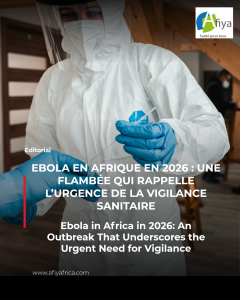
Ebola in Africa in 2026: An Outbreak That Underscores the Urgent Need for Vigilance
Virchow Prize 2026: Jean-Jacques Muyembe and the Rise of African Scientific Excellence