
 0
0
 0
0
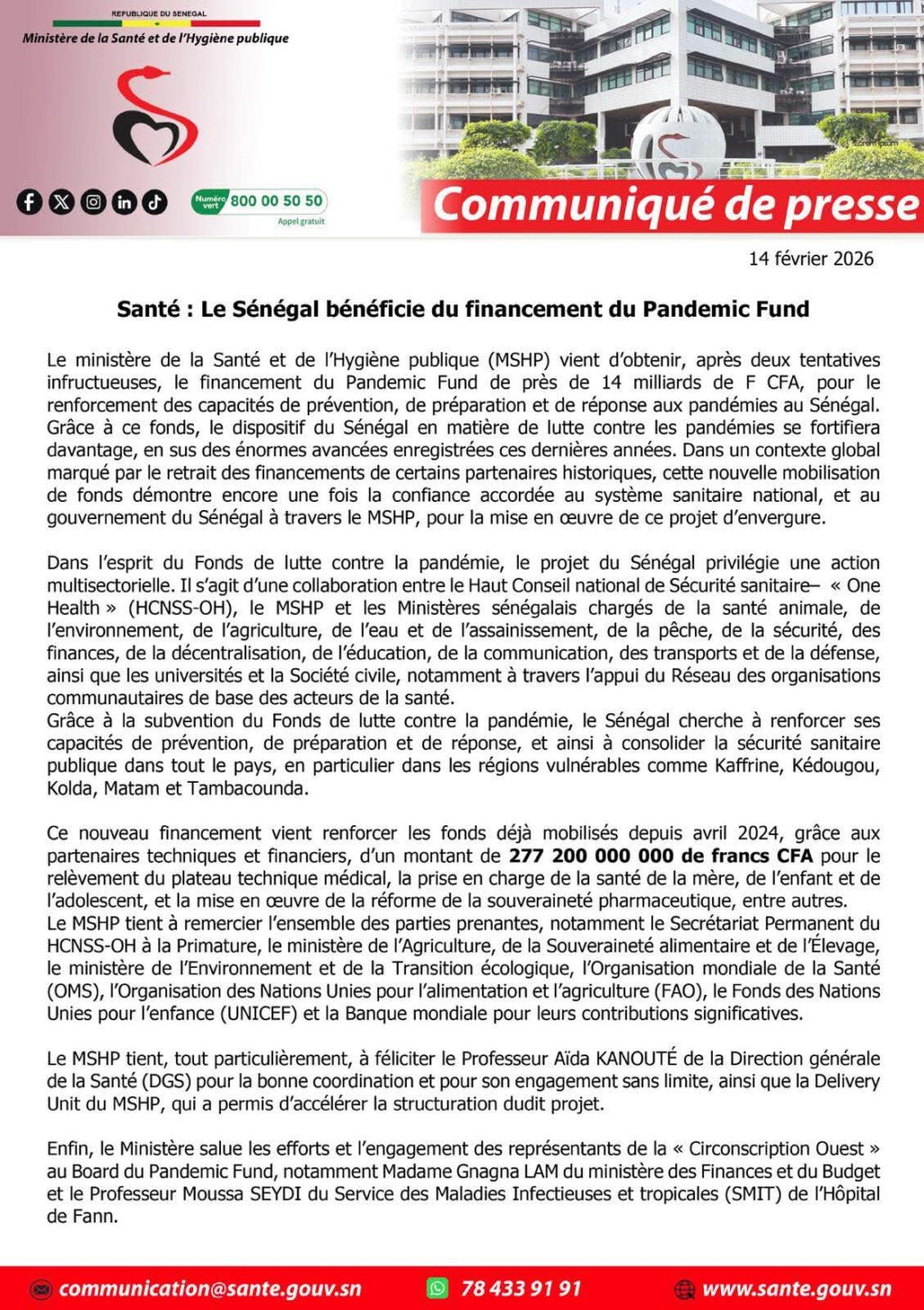
Senegal was awarded US$24.62 million from the Pandemic Fund to strengthen the country’s prevention, preparedness, and response capabilities through a One Health approach. The grant mobilized an additional US$60 million in co-financing from multilateral and global health organizations, and US$106.8 million in co-investment from the government’s own budget. The project’s range of partners includes organizations such as the Africa One Health University Network, the Global Fund to Fight AIDS, Tuberculosis, and Malaria, the Institute for Health and Development at the Faculty of Medicine in Dakar, KOICA, and others.
Senegal enjoys a number of strengths when it comes to fighting pandemic threats, including One Health trainings and collaborative outbreak investigations. Nonetheless, gaps in the country’s public health architecture remain, including a shortage of qualified epidemiologists, biologists, and risk communication and community engagement specialists. Shifting agricultural, livestock, and fishing practices, for example, are increasing contact among humans, domestic animals, and wildlife, which in turn increases pathogens’ ability to spread. Migratory birds flying across Senegal’s vast network of protected areas are conduits for the spread of pathogens, too. As a result, several epidemics have swept through the country, including measles, Rift Valley fever, Crimean-Congo haemorrhagic fever, dengue fever, vaccine-derived poliomyelitis, chikungunya, COVID-19, and highly pathogenic avian influenza.
In the spirit of the Pandemic Fund, Senegal’s project emphasizes multisectoral action. It is a collaboration among the Haut Conseil National de la Sécurité Sanitaire-One Health, the Ministry of Health and Social Action, and the Senegalese ministries responsible for animal health, environment, agriculture, water and sanitation, fisheries, security, finance, decentralization, education, communication, transport, and defense.
The project has three implementing entities: the Food and Agriculture Organization of the United Nations (FAO), UNICEF, and the World Bank.
Project objectives
With its Pandemic Fund grant, Senegal seeks to strengthen its prevention, preparedness, and response capabilities and thereby shore up public health security across the country — particularly in vulnerable regions including Kaffrine, Kedougou, Kolda, Matam, and Tambacounda.
Implementation arrangements and key components
Senegal’s project encompasses the Pandemic Fund’s priorities – surveillance, laboratory systems, and workforce development – as well as the Fund’s underlying themes, including One Health and community engagement. Additional detail on the project’s components follows.
Strengthening surveillance. Activities in this area are intended to enhance early detection. They focus on improving the country’s surveillance of food-, water-, and vector-borne diseases, as well as AMR surveillance, community-based surveillance, and environmental and sentinel surveillance. Additional activities include improving logistics for taking and preserving samples and distributing personal protective equipment, as well as establishing intersectoral data-sharing mechanisms and integrating data management.
Upgrading laboratories. This component of the project focuses on deploying rapid diagnostic capabilities, establishing integrated systems for sample transport and data sharing, and implementing a national biosafety and biosecurity system. It also includes the creation of two national networks: a One Health laboratory network and an integrated laboratory network for antimicrobial resistance surveillance, as well as reporting on the Global Antimicrobial Resistance and Use Surveillance System platform.
Developing the health workforce. In this area, activities include setting up a training program for the community-based One Health approach, developing a training plan for risk communication and community engagement, and strengthening the capacity of community actors in prevention, preparedness, and surveillance. Additional activities include boosting the skills of surveillance agents in field epidemiology, GEMP, and public health emergency management, and skilling veterinary and para-professional agents, park and marine protected area agents, and water and forestry agents in wildlife surveillance. The project will also focus on developing One Health standard operating procedures and organizing country-level simulation exercises.
The FAO’s support will focus on AMR, zoonotic diseases, laboratory strengthening, biosecurity, and workforce development. UNICEF will focus on community engagement and social mobilization, as well as water, sanitation, and hygiene. The World Bank will focus on resource mobilization, coordination, and a range of other project activities.
Expected outcomes
With the Pandemic Fund grant and the collaboration of its partners, Senegal aims to:
Improve surveillance systems for efficient, early detection using the One Health approach
Strengthen rapid diagnosis, characterization, and confirmation capabilities at the country’s laboratories, and
Increase the capacity of the multisectoral health workforce.
Note: This project description is based on the project proposal and information available as of February 2026.


About Author


OTHER ARTICLES
Ten ambulances and medical equipment strengthen emergency care in The Gambia
Afiya List 2025 : 25 personalities who made an impact on health in Africa in 2025
World Malaria Day: Real Progress, but the Battle Is Far from Over